
Mental Health Programs
(Funded by Atlantic Philanthropies)
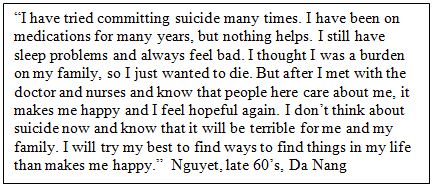
Research undertaken by the World Health Organization has shown that five of the leading causes for disability around the world are related to mental health disorders, accounting for 28 precent of disability. Common mental disorders like depression and anxiety are the largest contributors to mental health problems around the world. In Vietnam, the majority of mental health problems remain unidentified and therefore untreated. The National Mental Health program in Vietnam, conducted since 2001, mainly focuses on schizophrenia and epilepsy. The treatment relies heavily on pharmacotherapy with limited psychotherapy, social intervention, and rehabilitation. There is still a substantial gap between the needs of Vietnam’s mental health care system and the integrated and community-focused services recommended by WHO. International experience shows that, when done effectively, early intervention and treatment for people with mental health disorders can help reduce the burden of such disorders experienced by individuals, family members, and the community. IC-VVAF started its new program on Mental Health in January 2006 with the financial support of Atlantic Philanthropies. The first phase focused on need assessment, while the second phase worked on introducing community-based management system for depression.

Mental Health Program Phase 1 (2006-2007):
The program’s initial phase included an extensive needs assessment that was conducted in Da Nang and Khanh Hoa provinces to collect information about the prevalence and burden of the most common mental disorders. The survey also collected data about individuals and families affected by mental health problems, as well as the availability of mental health services in those regions. IC-VVAF then analysed the gap between needs and supply in mental health care. The survey revealed a high burden of mental health problems, with 23.6 percent of adults in Khanh Hoa province and 37.2 percent of adults in Da Nang province struggling with mental health issues. Depression and anxiety were the most prevalent issues, with 16.6 and 18.3 percent of adults experiencing these disorders in Khanh Hoa and Da Nang provinces, respectively.
This study also exposed critical shortages in the Vietnamese provincial mental health care system in both hospital and primary care settings. Overall, hospitals are understaffed and overloaded and consequently focus on the diagnosis and treatment of severe mental disorders, with depression and anxiety generally unidentified and untreated. In the primary health care settings where people often come first for their health needs, a large number of general health workers and medical practitioners are trained to identify and treat physical, rather than mental illness. General health workers could effectively provide treatment for common mental health problems, including depression and anxiety, in both settings if appropriate training was provided.
Mental Health Program Phase 2 (2009-June 2012):
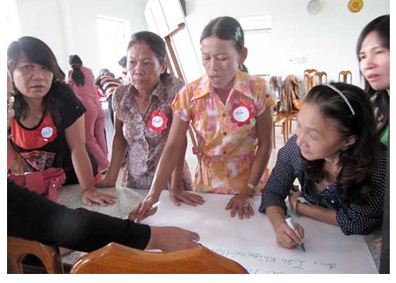
IC-VVAF executed a community-based mental health project in partnership with Da Nang and Khanh Hoa Departments of Health and Da Nang and Khanh Hoa Psychiatric Hospitals, with technical assistance provided by a team from the US National Institute of Health (Fogarty International Centre), Vanderbilt University, and Rand Corporation.
The IC-VVAF project for implementing a collaborative stepped-care model for persons with depression went through a well-coordinated process of sequential phases: preparatory (8 months), formative (6 months), pilot (14 months) and implementation (12 months). In keeping with the objectives and log frame, the project was conveniently divided into three major domains: the clinical interventions embedded in the CHS; the systemic engagement and capacity building activities across sectors; and information provision to local communities that supported and enabled the project at the commune health services. Through the introduction of the collaborative stepped-care model into primary health care systems, this project has achieved the specific objectives of increased availability of mental health resources and improved utilization of community mental health care services for management of depression. In this project, treatment services for people with depression were provided in primary care settings where there are no mental health specialists or psychiatrists. The patients received both medication and psychotherapy treatment in a collaborative manner provided by a team of commune health station general practitioners, nurses, and village health workers under supervision of mobile psychiatrists. After three and a half years of implementation, 39,749 people between ages 18 and 65 in the piloted communes of Da Nang and Khanh Hoa were screened. Of these, 4,380 people were identified to be at high risk of depression and 844 were diagnosed as depressed patients that should be treated.
Through implementing the community-based mental health care interventions in Da Nang and Khanh Hoa, IC-VVAF has established partnerships with national and provincial mental health officials. These partnerships have sparked government interest and engagement in developing a community-based integrated and comprehensive mental health system. IC-VVAF’s mental health program has shown how non-medication treatment for mental health issues can be more accessible and how mobilizing non-specialists in providing mental health care services in primary health care settings can be a feasible project. These two accomplishments can provide a good reference point for decision makers to develop and expand comprehensive mental health services, as well as to develop a mental health workforce that includes multi-disciplinary providers.
IC-VVAF’s community mental health care project has also contributed to strengthening the primary health care system in selected localities through promoting a team-based care management approach that builds capacity for primary health care providers. The program has helped to improve the quality of primary care and accelerate community-based service delivery that improves the accessibility and equity of care.
Mental Health Program Phase 3 (2013-2015):
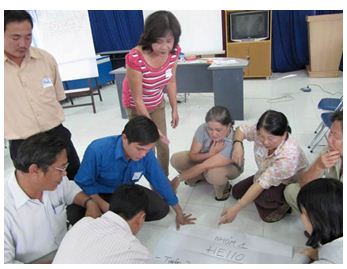
IC-VVAF is currently working closely with the International Center for Mental Health of the University of Melbourne to provide technical support and assistance through partnerships of national and international technical agencies to the Ministry of Health and Ministry of Labour, Invalids and Social Affairs in the development and implementation of an Integrated Mental Health System that incorporates Prime Ministerial Decision 1215/QD-Ttg Project, Community-Based Assistance and Functional Rehabilitation for Mental Ill and Mentally Disordered Project (2011-2020).